Russia Partnership Details
The HopeRussia ministry is restructuring to better accomplish two goals: Relationship and Stewardship. This article will first outline the structural change, and then we will discuss the goals. Structurally, we are shifting from a hub and spoke arrangement to one unified team of supporting churches. The new team will have an annual meeting that rotates among all of the US supporting churches. Every other year the meeting will take place in St. Petersburg, RU. The graphic below outlines our present hub and spoke structure.
Hub and Spoke Results in Silos (Mixed Metaphor)
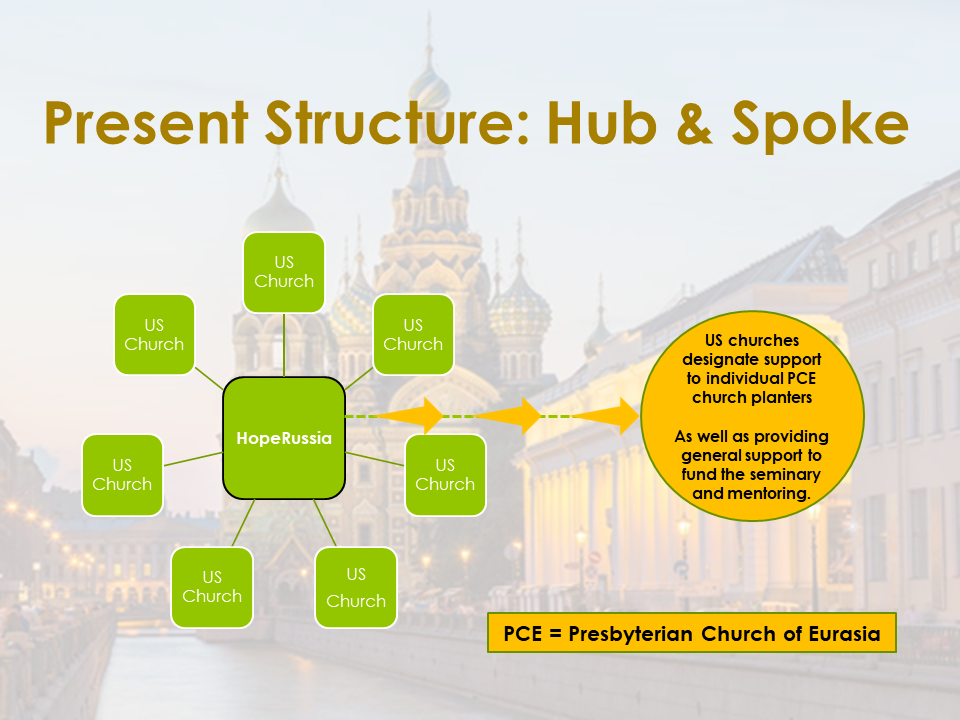
Many churches faithfully supporting HopeRussia seminary.
Several churches also supporting individual PCE church planters. But a more global view would help these supporting churches.
Present US Structure is unable to keep up with the ministry growth in the field. For example, our church planter in Vladivostok is launching his second church plant and lacks startup funding. Our church planter in Latvia has maxed-out his small worship facility and needs a larger place to meet.
New Structure: Centralize Team to Decentralize Oversight and Strengthen Relationships
Each supporting church sends a representative to annual meeting which will rotate among the supporting churches. Every other year the meeting will be in St. Petersburg, RU.
Meetings in the US will always include some of our Russian church planters and pastors.
Russians traveling to the US every year can more-frequently visit supporting churches.
Minimum giving per member church: $5,000 annually.

Two Goals: Relationship and Stewardship
Relationship: The plan outlined above is really nothing new, because many missionaries have been moving away from the hub and spoke model to the partnership model for quite some time. The facts are that the centralized partnership structure fosters deeper relationships between the folks in the target country and the members of supporting churches in the US. The discipline of the annual meeting makes it automatic for people to get together, providing opportunity for the Holy Spirit to build cross-cultural koinonia, a “sacred space” for those on the field (American missionaries and Russian church planters) and those of us in the sending country to relate to one another on a deeper level.
Stewardship: We hope that the partnership will increase each member church’s experience of owning the ministry. Of course, it belongs to our Lord Jesus, but we at HopeRussia want to do a better job of “giving the ministry away.” We want giving the ministry away to be more than a cliche. Silos are good for animal feed, but don’t provide for missionaries in need. For each member church, the annual meeting will provide a clear and detailed global view of the ministry’s financial picture enabling greater participation in the decision-making process and in casting vision for the future. We hope that the partnership will facilitate a growing number of churches catching a glimpse of the needs and opportunities in the field, thereby doing a better job of fueling the ministry. For example, our seasoned church planter near Vladivostok is launching his second church planting project, and we want lots of churches to become aware of this opportunity.
Blake Purcell says, “The Partnership is the next big step for our ministry.”
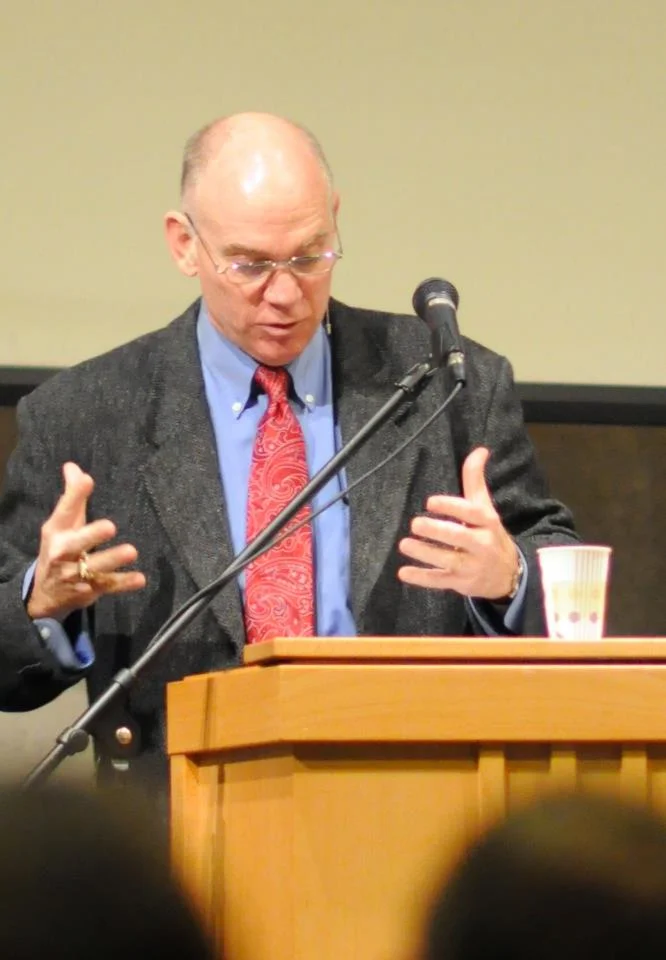
Rev. Blake Purcell
HopeRussia Founder and President, Blake Purcell says, “As you know, a few years ago we launched the Presbyterian Church of Eurasia. The PCE is led by five teaching elders (shown below) who are planting churches in St. Petersburg, and elsewhere. Having launched the PCE, we’re becoming increasingly aware that the Americans involved in this equation can provide more holistic support for these men, their families and ministries if we join together as one team rather than serving them as individual supporting churches. In other words, right now, HopeRussia facilitates several partnerships between individual churches and individual PCE church planters in the Russian-speaking world. But we’ve recently learned that in several regions where missionaries serve, they have coalesced these international partnerships (plural) into one partnership structure (singular). This partnership model is working well―for example―in Bangladesh and in Kuala Lampur. These partnerships seem to be serving the nationals on the field in much more robust manner than individual supporting churches can do alone. I believe that the Russia Partnership will become the central component of our ministry going forward.”
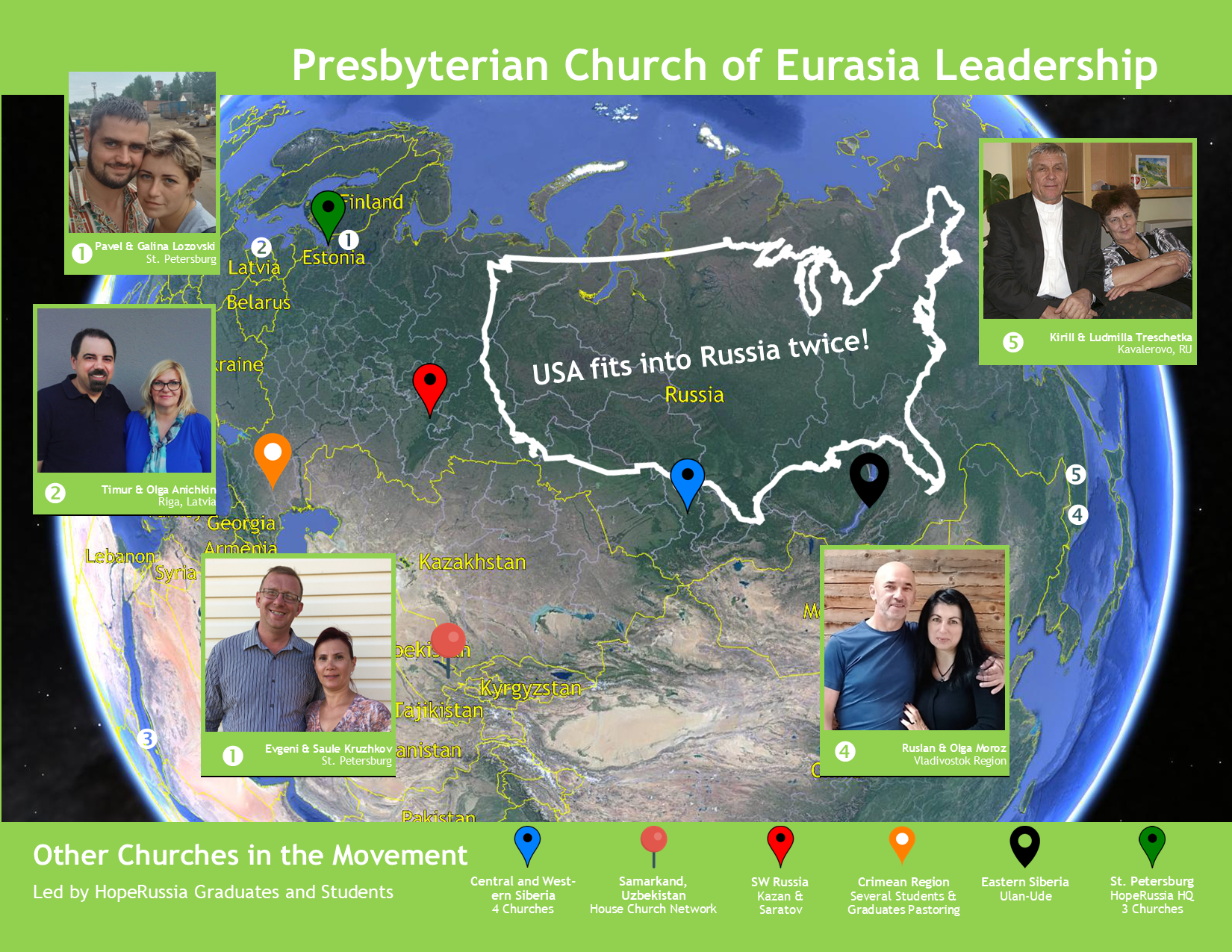
HopeRussia’s students & graduates (our PCE churches + other churches in the movement) pastor approx. 25 churches comprising 3,000 members.
Russia Partnership Commitments
We would love for your church to be a founding member of this new venture! Several details remain to be announced because the partnership is just now forming, and the initial group of churches to join the partnership will help to define what it means to be a member. Commitments will include:
Sending a representative to the annual Russia Partnership meeting, the location of which will rotate from church to church throughout the partnership. This will be a one-day meeting beginning with dinner the previous evening.
Hosting and featuring a PCE leader at your church once every two years. Their trip to your church can include preaching or teaching through a translator and/or having a Russia Partnership Banquet or gatherings in homes.
Annually informing the partnership of your church’s giving intentions for the coming year. The annual giving threshold for membership is $5,000.